

Guide to Industrial Temperature Sensors
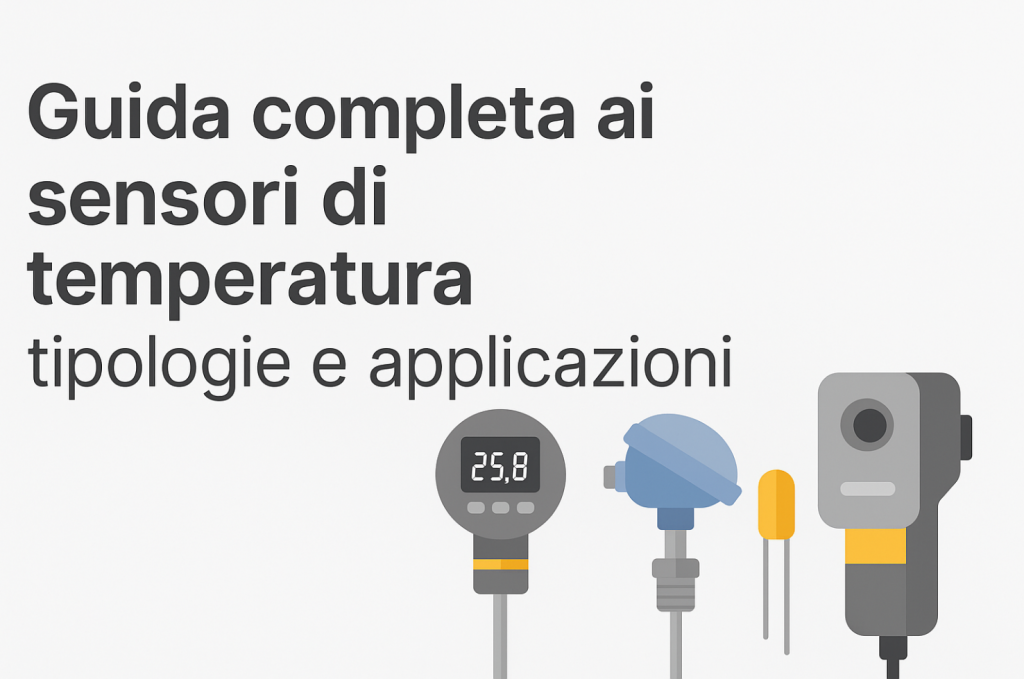
Discover types, operation, and applications of thermal probes for industrial automation. Selection criteria and custom solutions by CAP IT srl
Introduction: The Importance of Thermal Monitoring in Industrial Processes
In the world of automation and instrumentation, temperature measurement is one of the most critical parameters. Incorrect, unstable, or delayed thermal detection can seriously compromise plant safety, operational efficiency, and the high quality of the final product. The consequences of incorrect readings translate directly into costly machine downtime, production waste, energy inefficiencies, or serious risk situations.
Industrial temperature sensors are fundamental tools for intelligently monitoring and managing production flows. For this reason, the choice of the ideal thermal probe must be based on an accurate engineering analysis of the operating conditions, fluids, and objectives of process control.
What is an Industrial Temperature Sensor For?
A thermal detection device measures and transmits the temperature variation of a fluid, a mechanical component, or an operating environment. Specifically, these instruments are essential for:
- Monitoring temperature in sterilization cycles in autoclaves and ETO systems.
- Controlling industrial furnaces, boilers, incinerators, and metallurgical plants.
- Regulating chemical, petrochemical, and food processes.
- Ensuring production quality and process validation (pharmaceutical and medical sectors).
- Preventing critical failures or plant malfunctions due to overheating.
Thanks to perfect integration with PLCs, SCADA systems, and IoT architectures, the latest generation of thermal sensors allow real-time data collection for predictive maintenance and optimization of energy consumption in the context of Industry 4.0.
The Main Types of Temperature Sensors
1. Thermocouples (TC)
Industrial thermocouples generate an electrical voltage proportional to the temperature by exploiting the Seebeck effect (the junction of two different metal conductors).
- Advantages: Wide temperature range (up to over 1800°C), high mechanical robustness, and extremely fast response times.
- Ideal applications: Industrial furnaces, turbines, boilers, steel industry, Oil & Gas, and high-stress processes.
2. Resistance Temperature Detectors (RTD – Pt100 and Pt1000)
RTD resistance thermometers detect temperature through the variation of the electrical resistance of a sensitive element made of noble metal, typically platinum (in the well-known Pt100 or Pt1000 configurations).
- Advantages: Extremely high accuracy, excellent long-term stability, linearity, and perfect measurement repeatability with low drift over time.
- Ideal Applications: Food industry, fine chemicals, pharmaceuticals, biotechnology, and accurate process automation.
3. Thermistors (NTC and PTC)
Thermistors are highly sensitive semiconductor sensors, ideal for more limited temperature ranges.
- Advantages: Exceptional thermal sensitivity and miniaturized dimensions for tight spaces.
- Ideal Applications: HVAC systems (heating and air conditioning), industrial electronics, and environmental control systems.
4. Infrared Sensors (Non-Contact IR)
Infrared temperature sensors and pyrometers measure the thermal radiation emitted by an object without the need for direct physical contact.
- Advantages: Safe distance measurement, ideal for moving surfaces or equipment, and zero risk of contamination.
- Ideal Applications: Packaging lines, conveyor belts, rotating mechanical parts, and thermographic maintenance.
5. Custom Sensors and Tailored Solutions
When standard catalog models are not sufficient, the engineering of custom temperature sensors allows for maximum reliability even in the most extreme conditions. CAP IT designs tailored solutions to address:
Highly corrosive fluids and chemicals.
Particular geometries and space constraints (special dimensions).
High-pressure operating conditions (even above 400 bar).
Potentially explosive atmospheres (ATEX environments with dedicated designs).
Guidelines for Choosing a Temperature Sensor
To identify the ideal measurement technology, the following engineering variables must be evaluated:
- Temperature Range: This is the primary criterion. Some technologies are suitable for low cryogenic temperatures (down to -200°C), while others are essential above 1000°C.
- Installation Environment: Stress directly affects sensor lifespan. In the presence of high pressures, vibrations, ATEX atmospheres (gas or dust), or corrosive agents, it is crucial to choose appropriate materials, sheaths, and protective thermowells.
- Required Accuracy: Not all processes require the same level of tolerance. In fine control and pharmaceutical applications, stability is paramount; in other contexts, mechanical resistance is more important.
- Response Time: The speed at which the sensor must register thermal changes to avoid process drift.
- System Compatibility: Direct interface and clean communication with existing control systems (PLC, SCADA, IoT protocols).
The Experience of CAP IT srl
CAP IT srl supporta attivamente le aziende nella selezione, configurazione e integrazione dei sensori di temperatura industriale. Grazie a un profondo know-how tecnico e alla spiccata capacità di personalizzazione (co-engineering), l’azienda realizza sensori su misura per applicazioni standard ed estreme, garantendo dispositivi affidabili, sicuri, calibrati e pienamente conformi alle normative internazionali vigenti.
FAQ – Domande Frequenti
Qual è il sensore di temperatura più preciso?
In generale, le termoresistenze (RTD) come le sonde Pt100 offrono la massima precisione, linearità e stabilità, in modo particolare nei range di temperatura medio-bassi.
Quale sensore dura di più in ambienti gravosi?
Le termocoppie, grazie alla loro semplicità costruttiva e assenza di componenti fragili, garantiscono un’elevata durata operativa anche in presenza di altissime temperature, forti vibrazioni e pressioni elevate, purché dotate del corretto pozzetto di protezione.